Retroreflectometer for Traffic Sign: Improving Nighttime Road Sign Visibility
Traffic signs provide essential information to drivers, including warnings, directions, regulations and other road guidance.
Their effectiveness depends partly on whether motorists can recognise and read them under different environmental and lighting conditions.
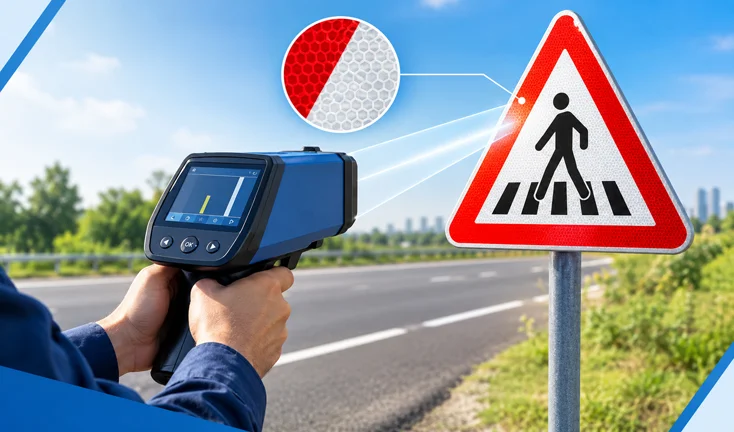
A Retroreflectometer For Traffic Sign helps measure the retroreflective performance of sign materials and supports road asset maintenance.
What Is Retroreflection in Traffic Signs?
Retroreflection refers to the ability of a surface to return incoming light toward its source.
Many traffic signs use retroreflective sheeting to make their information visible when illuminated by vehicle headlights.
The performance of the material can be influenced by its construction, condition, installation and exposure to environmental factors.
Why Does Traffic Sign Testing Matter?
Traffic signs experience continuous exposure to sunlight, rain, dust and other environmental conditions.
Over time, their reflective performance may decline.
Testing provides measurable information about the condition of the retroreflective material.
It can support decisions about sign maintenance and replacement.
How Is Retroreflectivity Measured?
A traffic sign retroreflectometer measures returned light under defined illumination and observation geometries.
The coefficient of retroreflection is commonly expressed as RA.
Measurements must follow the relevant testing procedure and be compared with the applicable material or maintenance criteria.
Applications of Traffic Sign Testing
Retroreflectivity testing can support:
- Highway sign inspections
- Urban traffic sign maintenance
- New sign material evaluation
- Road asset inventories
- Sign replacement planning
- Infrastructure condition assessments
It may also be useful when comparing material performance over time.
Traffic Signs vs Road Markings
Traffic signs and road markings are evaluated using different measurement arrangements.
A Retroreflectometer For Road Marking is relevant to pavement marking investigations, while vertical signs require suitable sign-testing equipment.
The correct instrument should be selected for the intended application.
Why Periodic Inspection Is Important
A sign may remain physically present while its retroreflective performance deteriorates.
Regular inspection helps road authorities identify material damage, contamination and declining visibility.
Measurements can be used alongside visual inspections to prioritise maintenance work.
Conclusion
Traffic sign retroreflectivity testing provides valuable information about road sign visibility.
Selecting appropriate equipment and maintaining a consistent inspection programme helps road agencies make informed decisions about sign performance and replacement.
15 blogs complete. Sabhi mein meta title, meta description, primary keyword, proper headings aur tumhari mapping ke according contextual internal links diye gaye hain.
Developer ke liye important: Primary keyword ke assigned URL aur content mein diye gaye internal links ko change nahi karna hai. Meta Title aur Meta Description ko blog ke SEO fields mein add karna hai, article ke visible content mein nahi.